Concept Paper ID : sjrbm.2026.11 | Open Access

Artificial Intelligence in customer relationship managArtificial Intelligence in Customer Relationship Management: A Conceptual Framework for AI-driven retention, personalisation, and sustainable business growth


Monika Bhatia, Dinesh Bhatia
Submission Date : March 17, 2026 Publication Date : July 14, 2026


Artificial Intelligence (AI) has fundamentally transformed how organisations manage and sustain customer relationships in competitive business environments. This paper presents a conceptual review and framework examining the role of AI in Customer Relationship Management (CRM), with particular emphasis on three strategic pillars: predictive customer retention, personalised service delivery, and sustainable business growth. Drawing on a synthesis of recent literature spanning AI-driven analytics, machine learning, natural language processing, and Explainable AI (XAI), this study proposes an integrated AI-CRM framework that maps specific AI capabilities to CRM functions and measurable business outcomes. The paper further identifies key ethical considerations—including data privacy, algorithmic bias, and regulatory compliance—as essential dimensions of responsible AI deployment in CRM. By situating the discussion within an Information Systems Management perspective, the paper contributes a structured conceptual model intended to guide researchers and practitioners in designing AI-enabled CRM systems that are effective, transparent, and sustainable. Limitations of the current study and directions for future empirical research are explicitly acknowledged.
The integration of Artificial Intelligence (AI) into Customer Relationship Management (CRM) represents one of the most consequential developments in contemporary Information Systems Management. AI-enabled CRM systems have moved organisations far beyond traditional data storage and transactional record-keeping, enabling real-time behavioural analysis, predictive personalisation, and proactive customer engagement at unprecedented scale[1]  [29]  . As digital transformation accelerates across industries, the capacity to intelligently anticipate and respond to customer needs has become a defining source of competitive advantage.
Despite the growing volume of literature on AI applications in business, a notable gap remains in research that consolidates diverse AI capabilities—spanning machine learning, natural language processing, and explainable AI—within a coherent CRM framework grounded in Information Systems theory. Much of the existing work addresses specific technical applications, such as churn prediction in telecommunications or credit risk modelling in banking, without situating these contributions within a unified AI-CRM perspective[1]  [1]  . This fragmentation limits the theoretical and practical utility of such studies for CRM system designers and business strategists.
To develop a conceptual framework that maps AI capabilities to CRM functions and business outcomes, with the aim of informing the design of effective, ethical, and sustainable AI-enabled CRM systems.
In pursuit of this objective, the paper synthesises a broad body of recent literature, organises findings into thematic categories, and proposes an integrated AI-CRM framework. The framework identifies three strategic pillars—predictive retention, personalised service, and sustainable growth—as the core outcomes of AI-driven CRM, and links each to specific AI capabilities and enabling technologies. The paper is explicitly conceptual and review-based in nature; it does not present original empirical data but instead provides theoretical synthesis and a structured conceptual contribution.
Conceptual Synthesis Approach / Methodology

This paper adopts a conceptual review methodology, which is appropriate for the study’s objective of synthesising existing knowledge and proposing an integrated theoretical framework. Unlike empirical studies that collect and analyse primary data, conceptual research derives its contribution from the systematic integration, critical analysis, and reinterpretation of existing literature to produce new theoretical insights or structured frameworks[23] .
The literature search was conducted across major academic databases—including Scopus, Web of Science, Google Scholar, and IEEE Xplore—using the following primary search terms and their combinations: ‘Artificial Intelligence AND Customer Relationship Management’; ‘machine learning AND churn prediction’; ‘NLP AND CRM’; ‘Explainable AI AND customer analytics’. Priority was given to peer-reviewed articles published between 2019 and 2025, supplemented by foundational works where necessary.
The synthesis process involved three structured phases:

  1. Thematic categorisation: Identified articles were organised into four thematic domains corresponding to the literature review sections.
  2. Critical integration: Findings were analysed for convergent insights, contradictions, and research gaps that inform the proposed framework, moving beyond sequential summarisation.
  3. Framework construction: Integrated insights were used to construct the AI-CRM conceptual framework presented in Section (iv), mapping AI capabilities to CRM functions and business outcomes.

This approach allows the paper to move beyond descriptive enumeration of prior work towards synthesis and interpretation, consistent with the requirements of a conceptual contribution in the Information Systems Management domain.

This section organises existing research into four thematic domains:

  1. AI-driven predictive analytics for customer retention;
  2. Personalisation and intelligent automation in CRM;
  3. Explainable AI and ethical considerations; and
  4. The AI-CRM systems perspective. This thematic synthesis moves beyond sequential summarisation of individual studies to identify convergent insights, contradictions, and research gaps that underpin the proposed framework.

AI-Driven Predictive Analytics for Customer Retention
Customer retention is widely recognised as a foundational strategic priority, given that acquiring new customers typically costs five to six times more than retaining existing ones[30] . Predictive analytics powered by machine learning has emerged as the primary instrument through which organisations identify at-risk customers and deploy targeted interventions before disengagement occurs[29] [14] .
Ensemble learning methods—including Random Forest, Gradient Boosting Machines (GBM), and XGBoost—have consistently demonstrated superior predictive accuracy in customer churn forecasting across multiple sectors[3] [3] . These models analyse historical customer data encompassing usage patterns, transactional history, service interactions, and demographic profiles to identify complex, non-linear indicators of churn risk[8] [3] . Studies report predictive accuracies frequently exceeding 90% in well-constructed ensemble frameworks[34] .
A critical insight from the literature is the financial significance of even marginal improvements in churn prediction accuracy. Research indicates that a 5% reduction in customer churn can generate a 25-85% increase in profitability[15] , underscoring the return on investment associated with AI-driven retention systems. The telecommunications sector—characterised by annual churn rates of 30-35% post-COVID—has served as a prominent testbed for these methods, yielding validated models increasingly extended to banking, retail, and digital services[22] [10] .
Advanced deep learning architectures, including Long Short-Term Memory (LSTM) networks and convolutional neural networks, extend predictive capabilities further by capturing temporal patterns in customer behaviour, enabling dynamic, time-sensitive churn predictions[24] [20] . While computationally intensive, these approaches offer richer representations of customer lifecycle dynamics than static snapshot models.

Personalisation and Intelligent Automation in CRM
Beyond retention, AI enables CRM systems to deliver highly personalised experiences aligned with individual customer preferences, behavioural histories, and contextual states[13] [28] . Machine learning models applied to customer segmentation allow organisations to move from broad demographic categories to granular micro-segments, each served through distinct interaction strategies and tailored incentives[4] .
Natural Language Processing (NLP) and Large Language Model (LLM)-based embeddings have transformed customer service operations by enabling real-time sentiment analysis, intelligent chatbot interactions, and automated response generation[8] [26] . Virtual assistants powered by these technologies reduce response latency, improve first-contact resolution rates, and operate continuously without human intervention, significantly lowering operational costs while maintaining service quality[16] .
Reinforcement learning approaches have been applied to dynamic pricing and offer optimisation within CRM contexts, enabling systems to learn from ongoing customer interactions and adapt recommendations to maximise long-term customer lifetime value[35] . Such systems create self-improving CRM pipelines that continuously refine their strategies based on real-world feedback.

Explainable AI, Ethics, and Regulatory Considerations
The deployment of sophisticated machine learning models in customer-facing decisions raises important ethical and regulatory challenges. The opacity of many high-performing models—often described as ‘black boxes’—creates significant barriers to interpretability, accountability, and regulatory compliance[32] [31] . This is particularly consequential in CRM contexts where algorithmic decisions directly affect customer access to services, credit, and personalised offerings.
Explainable AI (XAI) has emerged as a critical design requirement for responsible AI-CRM deployment. Techniques such as SHapley Additive exPlanations (SHAP) and Local Interpretable Model-agnostic Explanations (LIME) provide post-hoc interpretability by quantifying the contribution of individual features to model predictions[25] [21] . These methods enable CRM practitioners to understand why a customer is predicted to churn and to design targeted, justifiable interventions.
Ethical dimensions extend beyond interpretability to encompass data privacy, informed consent, algorithmic fairness, and the risk of discriminatory outcomes[2] . Regulatory frameworks—including GDPR and sector-specific financial regulations—mandate transparency in automated decision-making, making XAI not merely a technical enhancement but a compliance requirement[12] . Literature consistently emphasises that AI-CRM systems must be designed with privacy-by-design principles and subject to ongoing auditing to ensure equitable treatment of all customer segments[7] .

The AI-CRM Systems Perspective
From an Information Systems Management perspective, the integration of AI into CRM is best understood as a sociotechnical transformation rather than a purely technical upgrade[1] [18] . The value of AI-CRM systems is not realised through algorithmic performance alone but through the organisational capabilities, data governance structures, and human-AI collaboration models that surround them[36] .
Recent scholarship emphasises the importance of strategic alignment between AI capabilities and CRM objectives, noting that poorly aligned deployments frequently fail to deliver anticipated business value despite technical sophistication[1] [13] . The design of effective AI-CRM systems therefore requires integrated consideration of technological, organisational, and customer experience dimensions within a coherent management framework[19] .

Theoretical and Managerial Implications
The proposed AI-CRM framework makes several theoretical contributions to the Information Systems Management literature. First, it provides a structured, multi-dimensional mapping of AI capabilities to CRM outcomes—extending beyond the fragmented, application-specific treatments prevalent in the literature. Second, it explicitly incorporates ethical governance and XAI as integral components of sustainable AI-CRM design, rather than treating them as peripheral concerns. Third, by anchoring the discussion within CRM lifecycle theory and relationship marketing, it provides a theoretically grounded vehicle for future empirical research.
From a managerial perspective, the framework offers CRM leaders a structured decision-support tool for AI technology selection and deployment planning. Organisations can use the capability-to-outcome mapping in Table 1 to prioritise AI investments aligned with their specific retention, service, or growth objectives. The classification in Table 2 further assists technology selection by linking AI tools to validated CRM functions and relevant literature benchmarks.
For CRM system designers, the framework highlights the importance of building interpretability and fairness into AI models at the design stage rather than retrofitting these properties post-deployment. The integration of XAI capabilities—specifically SHAP and LIME—within predictive retention modules is particularly recommended, as these tools enable CRM teams to understand and communicate the basis for automated decisions to both customers and regulators.

Ethical Considerations and Responsible AI in CRM
The deployment of AI in CRM systems generates substantial ethical responsibilities. Customer data—the foundational input for AI-CRM models—is inherently sensitive, encompassing personal, financial, and behavioural information. Organisations must implement robust data governance frameworks ensuring informed consent, data minimisation, purpose limitation, and breach notification, consistent with applicable regulatory standards such as GDPR[12] .
Algorithmic bias represents a further critical concern. AI models trained on historically biased data may perpetuate or amplify discriminatory patterns in customer treatment, particularly in domains such as credit assessment and personalised pricing [29]. Organisations must implement systematic bias auditing as a continuous operational practice, not merely a one-time validation exercise.
The growing regulatory emphasis on explainability—including the right of customers to receive explanations for automated decisions affecting them—makes XAI adoption a legal obligation in many jurisdictions, not merely a best practice[7] . CRM leaders must ensure that their AI systems can produce human-interpretable explanations for all customer-facing decisions.
 

This study has several limitations that should be explicitly acknowledged. First, as a conceptual and review-based paper, it does not present original empirical data. The proposed framework has not yet been validated through quantitative or qualitative fieldwork, and its propositions remain theoretical pending empirical testing.
Second, the literature synthesis, while broad, is not exhaustive. Selection of studies was guided by relevance to the AI-CRM theme and recency; studies published before 2019 were included selectively. Relevant works in non-English-language literature or in emerging market contexts may not have been fully captured.
Third, the framework is presented at a level of abstraction intended to ensure broad applicability across industries and CRM contexts. Sector-specific adaptations—particularly for industries with distinct regulatory environments such as healthcare and financial services—would require additional tailoring beyond the scope of this paper.
 
The Proposed AI-CRM Conceptual Framework

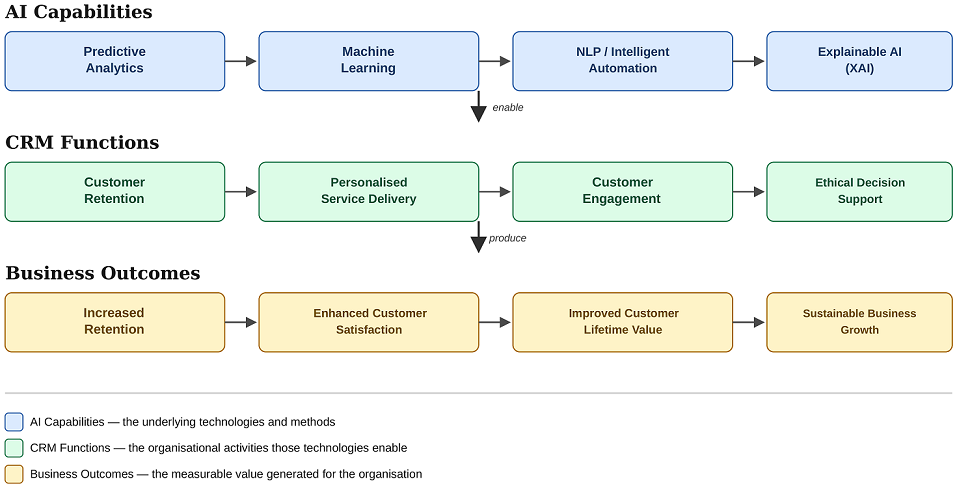
Based on the synthesis of literature, this paper proposes an AI-CRM Conceptual Framework organised around three strategic pillars: (i) Predictive Customer Retention, (ii) Personalised Service Delivery, and (iii) Sustainable Business Growth. Each pillar is enabled by specific AI capabilities and technologies, and produces measurable CRM and business outcomes. Table 1 provides a structured mapping of these dimensions, and Figure 1 presents the corresponding conceptual diagram.

Predictive Analytics Customer Churn Prevention Increased Retention Rate Random Forest, XGBoost, GBM
Natural Language Processing Sentiment Analysis & Service Enhanced Customer Satisfaction BERT, Transformer Models
Machine Learning Personalised Marketing Higher Conversion Rate Deep Learning, Neural Networks
Intelligent Automation Customer Onboarding & Support Reduced Operational Costs RPA, Chatbots, Virtual Assistants
Explainable AI (XAI) Ethical Decision Making Regulatory Compliance & Trust SHAP, LIME, Rule-Based Systems
Real-Time Analytics Dynamic Customer Engagement Improved Customer Lifetime Value Stream Processing, IoT Integration

Source: Authors’ synthesis from reviewed literature

Table 1 : AI-CRM Conceptual Framework — Mapping AI Capabilities to CRM Outcomes

Figure 1 : Conceptual Representation of the AI–CRM Framework — AI Capabilities Enabling CRM Functions to Produce Business Outcomes (corresponds to Table 1)

Figure 1 : Conceptual Representation of the AI–CRM Framework — AI Capabilities Enabling CRM Functions to Produce Business Outcomes (corresponds to Table 1)

Pillar I: Predictive Customer Retention
The first strategic pillar centres on the use of predictive analytics to identify and mitigate customer churn before it occurs. AI models—particularly ensemble methods such as Random Forest, XGBoost, and Gradient Boosting—analyse multi-dimensional customer data to generate churn probability scores, enabling proactive intervention through targeted retention campaigns, personalised incentives, or enhanced service touchpoints[3] [3] . The financial rationale is compelling: studies demonstrate that early churn prevention yields profitability improvements of 25-85% for a 5% retention gain[15] .
Within the CRM lifecycle, this pillar operates most effectively at the risk identification and intervention stages. AI models flag at-risk customer segments, CRM systems trigger automated or human-mediated responses, and feedback loops continuously refine model accuracy based on observed outcomes. Integration of XAI techniques within this pillar ensures that churn predictions are interpretable and actionable for CRM practitioners.

Pillar II: Personalised Service Delivery
The second pillar addresses the capacity of AI to deliver highly individualised customer experiences across all touchpoints. AI-powered recommendation engines, NLP-based sentiment analysis, and intelligent virtual assistants enable CRM systems to respond to each customer’s unique needs, preferences, and emotional states in real time[8] [26] [16] . This personalisation extends from product and service recommendations to communication channel selection, timing of outreach, and tone of interaction.
The organisational outcome of this pillar includes measurable improvement in customer satisfaction scores, net promoter scores (NPS), and first-contact resolution rates. Personalised engagement has been shown to significantly improve customer lifetime value by deepening emotional loyalty and increasing cross-sell and upsell conversion rates[27] .

Pillar III: Sustainable Business Growth
The third pillar situates AI-CRM capabilities within the broader strategic objective of sustainable business growth. By combining retention optimisation with personalised acquisition strategies, AI-CRM systems enable organisations to scale their customer base without proportional increases in operational costs[37] . Automation of routine CRM tasks—including query resolution, appointment scheduling, and complaint management—frees human resources for high-value relationship management activities, improving overall organisational efficiency.
Critically, sustainable growth in the AI-CRM context requires that ethical dimensions—data privacy, algorithmic fairness, and regulatory compliance—are embedded into system design from the outset. Organisations that deploy AI-CRM systems without adequate ethical governance risk reputational damage, regulatory sanctions, and erosion of customer trust, all of which undermine long-term sustainability[2] [12] .

Classification of AI Tools by CRM Application Domain
Table 2 provides a detailed classification of AI tools and methods mapped to specific CRM application domains, primary business functions, and representative supporting literature. This classification is intended to assist CRM practitioners and researchers in identifying appropriate AI technologies for specific organisational objectives.

AI Tool / Method CRM Application Domain Primary Business Function Representative Studies
Decision Tree Churn Prediction Retention Strategy Boozary et al. (2025); Chang et al. (2024)
Random Forest Customer Segmentation Personalised Marketing Bhuria et al. (2025); Tekouabou et al. (2022)
XGBoost / GBM Churn & Risk Prediction Revenue Optimisation Maan & Maan (2023); Imani et al. (2025)
Deep Neural Networks Behavioural Pattern Recognition Engagement Optimisation Imani et al. (2025); Liu et al. (2024)
NLP / LLM Embeddings Sentiment & Intent Analysis Customer Service Automation Chajia & Nfaoui (2024); Roy et al. (2025)
SHAP / LIME (XAI) Explainable Predictions Regulatory Compliance Rane et al. (2023); Misheva et al. (2021)
Chatbots / Virtual Agents Conversational CRM Cost Reduction & Availability Khneyzer et al. (2024)
Reinforcement Learning Dynamic Pricing & Offers Customer Lifetime Value Ortakci & Seker (2024)
Source: Authors’ synthesis from reviewed literature
Table 2 : Classification of AI Tools, CRM Application Domains, and Business Outcomes
This paper has presented a conceptual review and integrated AI-CRM framework addressing the transformative role of Artificial Intelligence in Customer Relationship Management. By synthesising a broad body of recent literature, the paper identified three strategic pillars—predictive customer retention, personalised service delivery, and sustainable business growth—as the core outcome dimensions of effective AI-CRM integration.
The proposed framework provides a structured mapping of AI capabilities to CRM functions and business outcomes, accompanied by a classification of AI tools across CRM application domains. These contributions are intended to serve as both a theoretical reference for Information Systems Management research and a practical decision-support tool for CRM leaders and system designers.
The paper explicitly acknowledges its conceptual nature and the consequent need for empirical validation, and it underscores the critical importance of ethical governance, transparency, and regulatory compliance as non-negotiable design requirements for responsible AI-CRM deployment. As AI technologies continue to evolve, organisations that combine technical sophistication with a commitment to ethical, human-centred design will derive the greatest long-term value from AI-CRM investments.
The framework proposed here is offered as a foundation upon which more specific empirical, methodological, and sector-specific contributions can be built. The convergence of AI capabilities and CRM strategy holds transformative potential for how organisations understand, serve, and sustain their customer relationships in an increasingly digital and competitive world.
 
The proposed AI-CRM framework opens several promising avenues for future research:

  • Empirical validation of the framework: Future studies should conduct primary research—through surveys, case studies, or experimental designs—to test the framework’s propositions across different industry sectors and organisational sizes. Structural equation modelling or fuzzy-set qualitative comparative analysis could be applied to examine causal relationships between AI capabilities and CRM outcomes.
  • Sector-specific AI-CRM model development: While the current framework is designed for broad applicability, future research should develop and validate sector-specific extensions for healthcare CRM, financial services, and e-commerce, each presenting distinct data characteristics, regulatory requirements, and customer relationship dynamics.
  • Longitudinal studies on AI-CRM impact: Longitudinal research designs would capture longer-term effects of AI-CRM deployment on customer trust, brand loyalty, and competitive position—dimensions that short-term studies cannot adequately address.
  • Human-AI collaboration in CRM workflows: Future research should examine optimal models for human-AI collaboration in CRM, including conditions under which AI recommendations should be deferred to human judgement and how CRM professionals can be trained to work effectively alongside AI tools.
  • Privacy-preserving AI in CRM: As data privacy regulations tighten globally, federated learning approaches—enabling model training without centralising sensitive customer data—represent an important frontier. Future research should assess the performance trade-offs and implementation challenges of such approaches in CRM contexts.
  • XAI usability for CRM practitioners: While SHAP and LIME provide technical interpretability, their practical usability for CRM practitioners without deep technical backgrounds remains understudied. Future research should examine how XAI outputs can be translated into actionable, comprehensible guidance for CRM decision-makers.
Figure 1 : Conceptual Representation of the AI–CRM Framework — AI Capabilities Enabling CRM Functions to Produce Business Outcomes (corresponds to Table 1)
Pain Text:
Monika Bhatia, Dinesh Bhatia (2026), Artificial Intelligence in customer relationship managArtificial Intelligence in Customer Relationship Management: A Conceptual Framework for AI-driven retention, personalisation, and sustainable business growth. Samvakti Journal of Research in Business Management, 7(2) .